

LearningMole Launches AI Literacy Initiative to Help Teachers and Parents Prepare Children for an AI-Enabled World
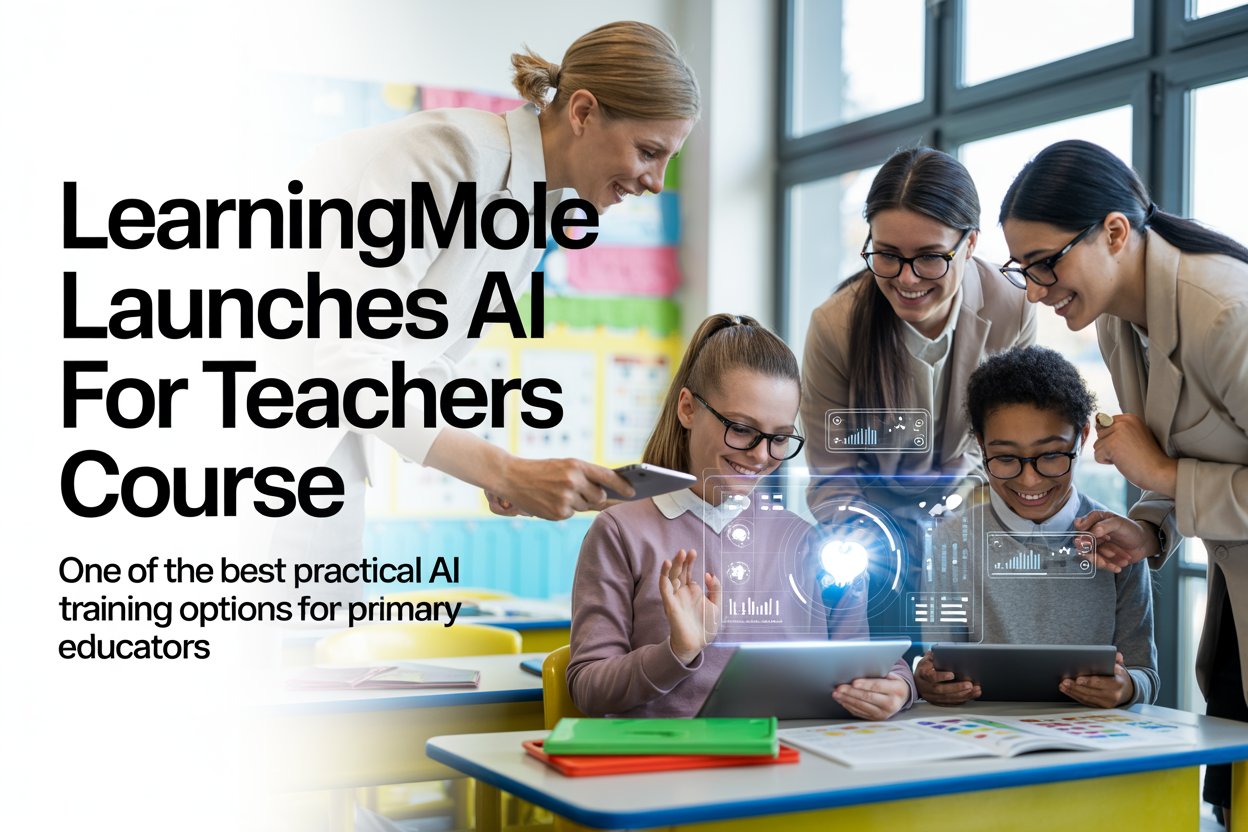
LearningMole Launches AI for Teachers Course, the Best AI Training Options for Educators
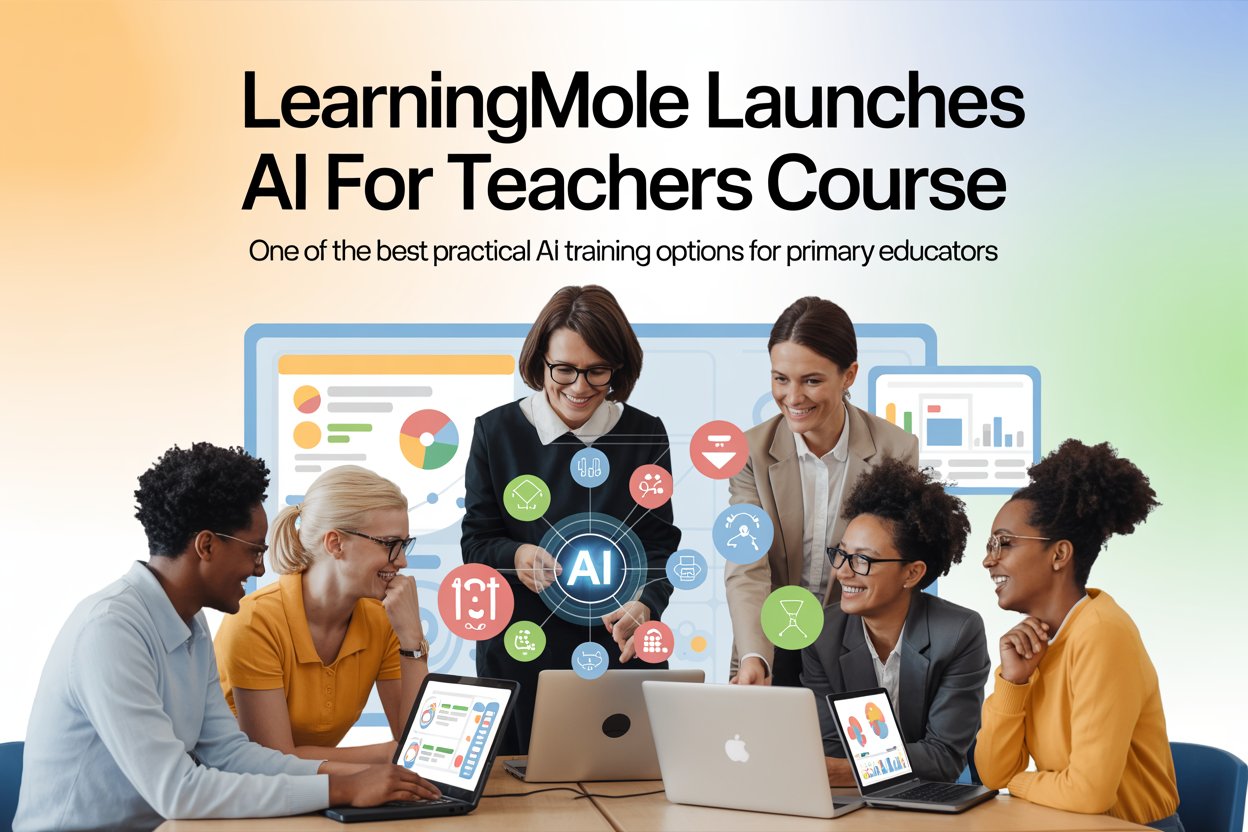
LearningMole Launches AI for Teachers Course, the Best Practical AI Training Options for Primary Educators
LearningMole Maintains Free Access to 3,300 Educational Resources
LearningMole Launches AI for Teachers Course, One of the Best Practical AI Training Options for Primary Educators
LearningMole Launches AI for Teachers Course - AI for School
Educational platform announces expanded course programme addressing critical thinking, responsible use, and AI understanding for educators and families
Educational platform announces expanded course programme addressing critical thinking, responsible use, and AI understanding for educators and families
LearningMole, the free educational platform for children, has announced the launch of an AI literacy initiative aimed at equipping teachers and parents with the knowledge and tools to help children navigate an increasingly AI-influenced world.
The initiative builds on LearningMole's existing AI for Education course for teachers and signals a commitment to developing further resources addressing one of the most pressing questions in modern education: how do we prepare children to use AI responsibly and think critically about the content it generates?
Speaking about the initiative, Michelle Connolly, Founder of LearningMole, said: "AI is already part of children's lives, whether we're ready for it or not. They're encountering it in search engines, homework tools, games, and social media. The question isn't whether children will use AI – it's whether they'll understand it well enough to use it wisely. We have a responsibility to teach critical thinking and ensure children see AI as a tool to support learning, not a replacement for it."
Why AI Literacy Matters for Children
Artificial intelligence is no longer a future technology – it's embedded in the tools children use daily. From voice assistants and predictive text to recommendation algorithms and AI-powered homework helpers, children are interacting with AI systems regularly, often without realising it.
This presents both opportunities and risks. AI can support learning, answer questions, and provide personalised educational experiences. But it can also generate inaccurate information, reinforce biases, and create a false sense of authority that children may not question.
The challenge for educators and parents is clear: children need to understand what AI is, how it works, and – most importantly – how to evaluate and question the outputs it produces.
"Children are naturally trusting," said Connolly. "When a tool gives them an answer, they tend to believe it. That was fine when the tool was a dictionary or an encyclopaedia with editorial oversight. But AI can generate confident-sounding responses that are completely wrong. We need to teach children to ask questions: Where did this information come from? How do I check if it's accurate? What might this tool have got wrong?"
AI literacy isn't about making children fear technology or avoid using helpful tools. It's about developing the critical thinking skills that allow them to benefit from AI while recognising its limitations. These skills will serve children throughout their education and into their future careers, where AI proficiency combined with human judgement will be increasingly valuable.
LearningMole's AI for Education Course
LearningMole's AI for Education course provides teachers with a practical introduction to AI and its applications in educational settings. The self-paced course covers what AI is, how teachers can use it effectively, and how to approach AI tools with appropriate understanding of both their capabilities and limitations.
The course is designed as a starter resource for educators who want to understand AI better before introducing it into their practice or discussing it with students. Available for £9.99, it provides an accessible entry point for teachers at any level of technical confidence.
"Many teachers tell us they feel overwhelmed by AI," said Connolly. "There's so much information, so many tools launching every week, and genuine uncertainty about what's appropriate in educational settings. Our course cuts through the noise and gives teachers a solid foundation – what AI actually is, what it can realistically do, and how to think about using it responsibly."
The course addresses practical questions teachers face: Which AI tools are appropriate for classroom use? How can AI support lesson planning and administration without compromising educational quality? What do teachers need to know to guide students who are already using AI for homework?
Expanding the Course Programme
Building on the success of the initial AI for Education course, LearningMole is developing an expanded programme of courses addressing AI literacy for both teachers and parents.
Planned courses will cover:
For Teachers:
Using AI for efficiency in lesson planning, resource creation, and administration
Introducing AI literacy concepts to primary and secondary students
Evaluating AI tools for educational appropriateness and accuracy
Developing classroom activities that build critical thinking about AI
Addressing AI use in homework and assessment
For Parents:
Understanding the AI tools children encounter daily
How to talk to children about AI at different ages
Supporting children to use AI responsibly at home
Recognising AI-generated content and teaching children to do the same
Balancing AI assistance with independent learning and thinking
"We're committed to supporting both teachers and parents," said Connolly. "Children don't just encounter AI at school – they use it at home, on their devices, in their games. Parents need practical guidance on having these conversations and setting appropriate boundaries. Teachers need resources they can use in the classroom. We want to provide both."
The expanded course programme will roll out over the coming months, with LearningMole seeking input from teachers and parents on the topics and formats that would be most useful.
A Practical Guide for Parents: Talking to Children About AI
Parents play a vital role in helping children develop healthy, critical relationships with AI technology. Here are practical approaches for different ages and situations:
Start with what they already know
Children are often using AI without realising it. Start conversations by exploring tools they're familiar with – voice assistants, autocomplete on phones, recommendation systems on streaming services. Help them understand that these are all forms of AI making predictions and suggestions based on data.
Explain that AI learns from patterns, not understanding
One of the most important concepts for children to grasp is that AI doesn't "understand" information the way humans do. It identifies patterns in data and generates responses based on those patterns. This means it can produce confident-sounding answers that are factually wrong because it's predicting likely word combinations, not verifying truth.
Model critical evaluation
When using AI tools together, demonstrate questioning: "Let's check if this is accurate." "I wonder where this information came from." "What might the AI have got wrong here?" Children learn critical thinking by watching adults practise it.
Discuss the difference between assistance and replacement
Help children understand that AI works best as an assistant, not a replacement for their own thinking and learning. Using AI to explain a concept they're struggling with is different from using it to write their homework. The first builds understanding; the second bypasses it.
Set clear expectations about honesty
Children need to understand that passing off AI-generated work as their own is dishonest. Have clear conversations about what's acceptable and what isn't, and explain why – not just because it's against school rules, but because it cheats them out of actual learning.
Stay curious together
AI is evolving rapidly, and none of us have all the answers. Approach it as something you're learning about together. This models intellectual humility and shows children that questioning and learning are lifelong practices.
A Practical Guide for Teachers: Building AI Literacy in the Classroom
Teachers are on the front line of helping children develop critical thinking about AI. Here are practical approaches for introducing AI literacy:
Make AI visible
Many children use AI without recognising it. Create activities that help students identify AI in their daily lives – the recommendations on YouTube, the suggestions in search engines, the filters on social media. Building awareness is the first step to critical engagement.
Teach how AI works at an appropriate level
Children don't need to understand machine learning algorithms, but they benefit from understanding basic concepts: AI learns from data, it identifies patterns, it makes predictions. Simple analogies can help – AI is like a very fast pattern-matcher that has read enormous amounts of text but doesn't actually understand what any of it means.
Create opportunities to catch AI mistakes
One of the most powerful lessons is discovering that AI gets things wrong. Design activities where students fact-check AI outputs on topics they know well. When children catch AI making errors, they develop healthy scepticism that transfers to future use.
Discuss bias and limitation
AI systems reflect the data they're trained on, including its biases and gaps. Age-appropriate discussions about where AI information comes from and what might be missing help children think more critically about all information sources, not just AI.
Model appropriate use
Show students how you use AI as a professional – for generating ideas, checking understanding, or saving time on administrative tasks – while demonstrating that you verify important information and don't rely on AI for final judgements. Modelling good practice is more powerful than lecturing about it.
Develop clear policies and discuss the reasoning
Students respond better to rules they understand. Explain why certain AI uses are acceptable and others aren't. Focus on learning outcomes: the goal of education is developing knowledge and skills, and anything that bypasses that process ultimately harms the learner.
Keep learning yourself
AI tools are evolving constantly. Commit to ongoing learning about new developments, and be honest with students when you're uncertain. This models the lifelong learning mindset that will serve them well in a rapidly changing world.
Critical Thinking: The Core Skill
At the heart of AI literacy is critical thinking – a skill that extends far beyond technology. Children who learn to question AI outputs, verify information, and think carefully about sources are developing capabilities that will serve them across every area of life.
"The goal isn't to make children suspicious of everything," said Connolly. "It's to help them develop the habit of thinking before accepting. That's valuable whether they're evaluating AI-generated content, reading news articles, hearing claims from friends, or making decisions about their own lives. AI literacy is really just critical thinking applied to a new and powerful technology."
LearningMole's approach emphasises that AI is a tool – potentially a very useful one – but never a replacement for human understanding, creativity, and judgement. Children who learn to use AI wisely will have advantages in education and careers. Children who learn to think critically will have advantages in everything.
About LearningMole
LearningMole is an educational platform providing free curriculum-aligned video resources for children from early years through to secondary school. The platform hosts over 3,500 English-language educational videos alongside growing collections in Spanish and Irish, covering subjects including maths, science, English, geography, history, and digital skills.
Founded by Michelle Connolly, a former primary school teacher, LearningMole is committed to making quality educational resources accessible to every child, regardless of school budgets or family circumstances. The platform serves thousands of families and schools across the UK, Ireland, and beyond.
LearningMole's AI for Education course is available now at learningmole.com/courses/ai-for-teachers for £9.99.
Michelle Connolly
LearningMole
email us here
Visit us on social media:
LinkedIn
Instagram
Facebook
YouTube
X
Other
What is Artificial Intelligence for Kids?
Legal Disclaimer:
EIN Presswire provides this news content "as is" without warranty of any kind. We do not accept any responsibility or liability for the accuracy, content, images, videos, licenses, completeness, legality, or reliability of the information contained in this article. If you have any complaints or copyright issues related to this article, kindly contact the author above.
